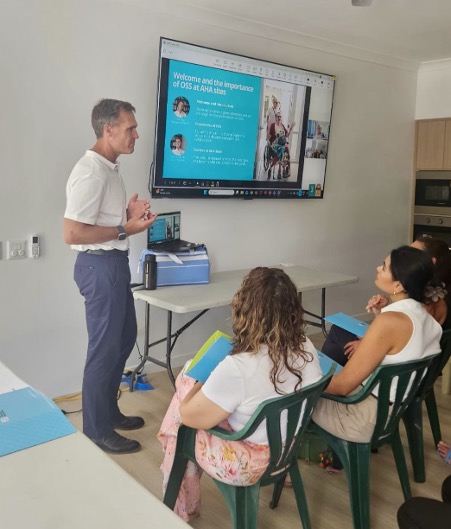
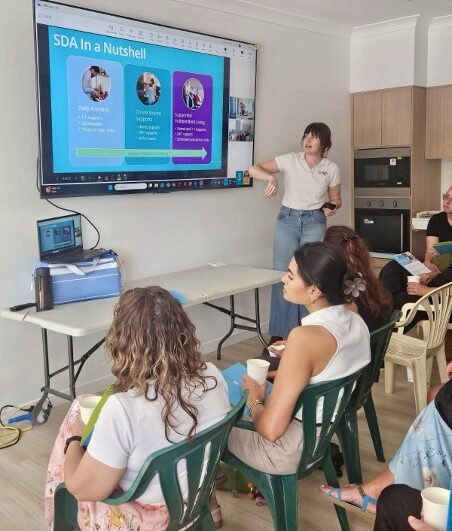
Last week in Hervey Bay, AHA brought together a room full of care providers to explore a support model that’s quietly transforming how people with high physical support needs live independently. Our Onsite Shared Support (OSS) workshop unpacked how 24/7 backup care can be delivered in a way that feels empowering, flexible, and community driven, all the while saving a participant funds in their NDIS plan. Here’s a clear and simple breakdown of the model and why so many providers are excited to be part of it.
What is OSS? A simple explanation
Onsite Shared Support (OSS) is a 24/7 support model delivered in clustered SDA settings. Providing shared supports to a group of tenants housed independently, it allows for around the clock care without having a support worker in-home all the time. SDA with OSS means:
- Tenants live on their own in their SDA home
- A support team is located on the same site, 24/7
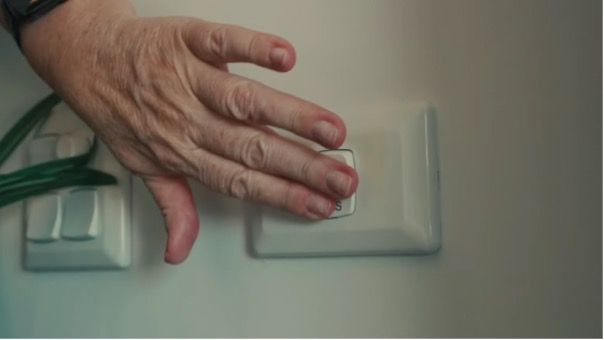
- Tenants can call for help via the buzzer system, giving them care when they need it, and independence when they don’t
- Greater autonomy for tenants while still ensuring support is always close by
- Is more cost effective than typical SIL funding
Think of OSS as a safety net that runs around the clock — support that’s “just next door” rather than “in your spare room”.
Why tenants choose this model
Many people needing SDA homes want to live alone or with a partner/child, instead of in a group home. OSS gives them that option by providing:
- 24/7 backup support from a worker based in the onsite OOA (On-Call Overnight Assistance) unit
- Scheduled 1:1 supports (personal care, community access, domestic support) that can be delivered by any provider that each tenant can choose independently, as separate from the OSS provider
- Ad-hoc help for the things that can’t be scheduled – a fall, a transfer that needs a second pair of hands, assistance in the bathroom, a late-night issue, or help with a task they can’t safely do alone
It typically suits people who:
- Have physical impairments
- Understand their support needs
- Can call for assistance using technology
- Want independence but need backup when required
Why care providers are interested
At our Hervey Bay workshop, we spoke with providers about what delivering OSS looks like in practice.
Care providers deliver OSS by:
- Staffing one dedicated OOA apartment on site
- Responding to calls from multiple tenants across the community
- Coordinating with each tenant’s primary support team
- Balancing scheduled tasks with ad-hoc requests
- Maintaining a moderate-intensity 24/7 roster
It’s not SIL, and it’s not meant to replicate SIL.
Instead, it focuses on supporting people to live alone; concierge-styled help with customer service at the heart of the model.
Providers told us this model allows them to deliver:
- More consistent, reliable care
- Stronger relationships with tenants
- A community-focused approach rather than isolated support shifts
How OSS works financially
For eligible tenants, the NDIA may fund a specific line item called “Unplanned onsite shared supports in SDA.” This is a line-item available to those eligible for SDA who have a strong preference to live alone, and meet the “living alone with onsite shared supports” eligibility criteria in the SDA Operational Guidelines.
This is a shared cost across the group, meaning the service becomes more affordable for each person, delivered at a significant cost-savings when compared to SIL.
Even where tenants do not have this exact line item yet, some can contribute through SIL or Core supports — something we discussed with providers at the workshop using real case examples from our existing sites on the Gold Coast.
What tenants say
Across AHA’s existing OSS sites, tenants describe the model as:
- “More independence, without losing safety.”
- “I can shower whenever I feel like it because help is minutes away.”
- “I’m part of a community, not isolated.”
- “It’s reduced my reliance on scheduled shifts and given me more freedom in my day.”
This balance – independence with guaranteed backup – is what makes OSS so impactful.
Looking ahead at Urraween Village
Urraween Village will be home to 12 single-level SDA villas and one OOA hub. With construction underway and strong demand already, the OSS provider selected by tenants will play a key role in establishing this new community.
The Hervey Bay workshop was the first step in preparing providers for that process.
Want to learn more?
AHA is offering free education sessions for organisations wanting to understand this model.
Get in touch if your organisation:
- Would like a free presentation on OSS and how it works
- Is interested in providing Onsite Shared Supports at an AHA site, OR
- Supports someone who may be interested in applying for an SDA villa at Urraween Village
We’d love to speak with you.